Parking in the UK: A Comprehensive Overview for Tenants, Purchasers, and Property Investors
Whether one is seeking a new residential tenancy, contemplating a property acquisition, or overseeing a portfolio of investment properties, parking represents a practical consideration that is frequently overlooked until it becomes a point of contention.
Within affluent urban centres such as Croydon, Purley, Sutton, and Bromley, the availability and nature of parking facilities can significantly influence a property decision. It impacts rental valuations, the velocity of property sales, and the overall quality of life for residents. Regrettably, it is often relegated to a secondary detail in property particulars, overshadowed by metrics such as the number of principal bedrooms or photographic representations of the kitchen.
This discourse aims to provide a thorough understanding of parking in the United Kingdom, encompassing the various classifications, legal ramifications, critical evaluation points, and their specific relevance within the local market context. It is intended to be of value to tenants, prospective purchasers, and property investors alike.
An Examination of UK Parking Classifications
Not all parking arrangements are equivalent. Prior to finalising a tenancy agreement or exchanging contracts, it is prudent to ascertain the precise nature of the parking provision and its practical implications.
Allocated Parking Spaces
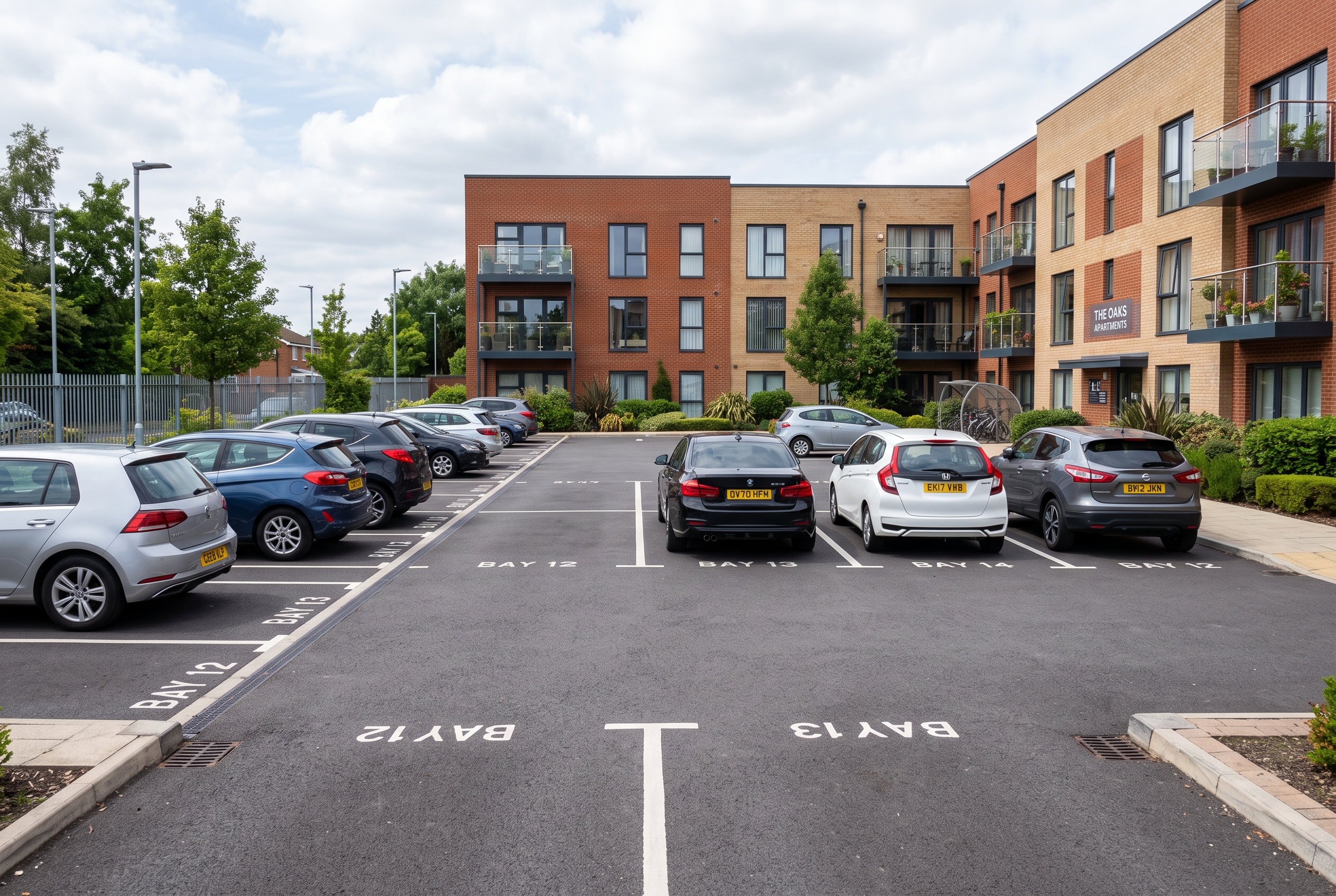
An allocated parking space denotes a specific, designated area assigned exclusively to a particular property. This may be situated within a communal car park, a private driveway, or a purpose-built bay.
Key considerations:
The allocation must be unequivocally documented, either within the tenancy agreement or the property's title deeds.
For leasehold properties, such as apartments, the parking space may be governed by a separate lease or licence, each carrying distinct legal implications.
Allocated spaces are generally regarded as the most desirable and least complicated form of parking arrangement.
Permit Parking Zones
Numerous residential thoroughfares within Croydon and its adjacent boroughs are designated as Controlled Parking Zones (CPZs), administered by the London Borough of Croydon or neighbouring local authorities. Within these zones, a resident's permit is requisite for parking on the street during specified restricted hours.
Essential information:
Permits are issued by the local council, not by the landlord or vendor.
The number of permits issuable per property may be subject to limitation; certain zones restrict issuance to one permit per household.
Permit zones do not guarantee the availability of a parking space; they merely confer the right to park should a space be vacant.
Provisions for electric vehicle (EV) charging points and blue badge holders are often addressed separately.
Direct consultation with the local council is advised to confirm permit eligibility before committing to a property.
On-Street Parking (Unrestricted)
Certain residences depend entirely on unrestricted on-street parking, necessitating neither a permit nor an allocated bay. This is prevalent on quieter residential streets situated away from commercial centres.
Practical realities:
Availability can fluctuate considerably based on the time of day and the density of the locality.
There are no assurances; one may be required to park at a considerable distance from one's residence.
Future modifications to parking regulations within the area could impact accessibility without prior notification to residents.
Garages
A garage is frequently presented as a significant amenity, yet it is advisable to make specific enquiries to ascertain its genuine parking utility:
Is the garage of sufficient dimensions to accommodate a contemporary vehicle? Many older garages were designed for smaller automobiles.
Is its structural integrity sound?
Is the garage included within the tenancy or sale, or is it let or sold independently?
Is access practical – i.e., is there a dropped kerb and adequate manoeuvring space?
In many instances, garages are utilised for storage rather than vehicular parking, a factor that warrants consideration during your assessment.
Driveways and Off-Street Parking
A private driveway constitutes one of the most practical and highly valued forms of parking. For purchasers, a driveway can serve as a significant differentiating factor. For landlords, it can justify a higher rental rate.
Points for evaluation:
Verify the presence of a dropped kerb and its official council approval.
Should a property lack a driveway but possess front garden space, it may be feasible to seek planning permission for its creation, albeit this involves associated costs and is not guaranteed.
Shared driveways can occasionally precipitate disputes; therefore, it is advisable to review the title deeds for any easements or shared access agreements.
Car Parks (Communal or Commercial)
Some apartments and residential developments offer access to a communal or managed car park, either incorporated within the service charge or available at an additional expense.
Aspects requiring verification:
Is the parking space owned, leased, or licensed?
What are the associated financial obligations (service charge, annual fee)?
What security measures are in place (gated access, CCTV surveillance, illumination)?
Are there height restrictions that might affect larger vehicles or vans?
The Influence of Parking on Property Value and Attractiveness
Parking transcends mere convenience; it exerts a quantifiable influence on property valuations and the speed at which properties are sold or let.
Market Metrics
Numerous property organisations have reported that off-street parking can augment a property's value by a range of £5,000 to £50,000, contingent upon the location. In London and densely populated commuter towns such as Croydon, the premium typically aligns with the upper echelon of this spectrum.
For rental properties, parking can justify a discernible increase in the asking rental price, particularly for families, commuting professionals, or tenants with specific accessibility requirements.
Purchaser Demand
For prospective purchasers, parking consistently ranks among the primary search criteria on property portals. A property lacking parking facilities in an area with limited on-street availability may remain on the market for an extended period and attract less favourable offers.
Tenant Demand
For landlords, parking represents a significant attraction for long-term, professional tenants, especially in locales where public transportation, whilst adequate, does not cater to all travel needs. A residence with secure, allocated parking is demonstrably easier to let and tends to retain tenants for longer duration.
Guidance for Tenants: Understanding Rights and Posing Pertinent Inquiries
If you are renting a property that includes parking facilities, it is imperative to comprehend your entitlements and associated responsibilities.
Essential Inclusions in Your Tenancy Agreement
Should parking be included as part of your tenancy, this must be explicitly detailed within your tenancy agreement. Pay close attention to:
The precise location or bay number of any allocated parking.
Whether parking is included in the rental sum or charged separately.
Any stipulations regarding vehicle types (e.g., prohibition of commercial vehicles or caravans).
Regulations concerning vehicles belonging to visitors.
Responsibilities pertaining to the maintenance of communal parking areas.
Crucial Note: If parking is not formally stipulated in your tenancy agreement, you possess no legal entitlement to it, irrespective of any verbal assurances. All such arrangements must be documented in writing.
Permit Zones: Tenant Considerations
In instances where the property is situated within a permit zone, your landlord should ideally confirm your eligibility to apply for a resident's permit. However, the permit itself is issued by the council in your name, not that of the landlord.
Recommended actions:
Consult the relevant council's website for details pertaining to the specific CPZ zone and its restrictions.
Ascertain the number of permits available per household within that zone.
Submit your application directly to the council; typically, proof of residency (your tenancy agreement usually suffices) is required.
Be advised that permits are subject to renewal, generally on an annual basis.
Parking Disputes
Disagreements concerning parking, whether with neighbours, other residents, or landlords, are unfortunately not uncommon. Should an unauthorised vehicle occupy your allocated space:
Initiate communication with your landlord or letting agent.
In managed developments, liaise with the managing agent or freeholder.
As a final recourse, it may be permissible to arrange for the removal of a vehicle obstructing private land, but this must be conducted via a licensed operator. Illegally clamping or obstructing a vehicle is prohibited.
Guidance for Landlords: Leveraging Parking as a Rental Asset
For landlords, parking is an amenity that warrants serious consideration.
Conclusion
From on-street restrictions to underground car parks and private bays, parking in the UK can be complex but with a bit of knowledge, it becomes manageable. Always check signs, understand local permit schemes, and make use of modern tools like parking apps to stay compliant.
Whether you're parking at home, at work, or on a weekend away, a little preparation goes a long way in avoiding unnecessary stress or worse, a ticket. https://youtube.com/shorts/d3xh_DbLYxE?feature=share