Deposit Alternatives Explained: How They Affect Landlords and Tenants

The Reality Behind Tenancy Deposit Alternatives
Deposits are a standard part of renting, designed to protect landlords and tenants, but in practice, deposit alternatives are increasingly being considered as a more flexible option.
landlords and tenants:
High upfront costs for tenants
Delays in move-ins
End-of-tenancy disputes
Even when deposits are protected in schemes, landlords may still face shortfalls if multiple issues arise like rent arrears, damage, or cleaning.
Deposit alternatives are optional schemes designed to smooth the rental process but they do not replace strong tenancy management, proper referencing, or clear agreements.
How Deposit Alternatives Work for UK Landlords and Tenants

Tenant referencing and approval
Checks affordability, rental history, and credit.
Payment of a smaller, non-refundable fee
Usually a fraction of a traditional deposit.
Landlord coverage
Protects against rent arrears, damage, or breaches.
Claims process
Landlords submit claims if issues occur; tenants may reimburse costs.
Tenants remain liable, and landlords must maintain proper records.
Pros for Tenants
Benefits
Lower upfront costs make renting more accessible
Better cash flow for moving or furnishing
Faster decision-making, reducing delays
Flexibility for short-term stays
Pros for Landlords
Benefits of Deposit Alternatives
Larger potential tenant pool
Reduced void periods due to lower upfront costs
Structured claims process
Optional tools to manage risk, not a replacement for inventories, referencing, or management
Risks of Deposit Alternatives
Key Risks
Non-refundable fees for tenants
Coverage limits vary by scheme
Dispute resolution differs from government backed schemes
Not all landlords accept these schemes
Liability for damages remains
Who Should Use Deposit Alternatives Suit
Ideal Scenarios
High-demand rental properties
Tenants with limited upfront cash but strong references
Situations where speed and flexibility are priorities
Works best with good management, clear agreements, and proper documentation,
Who Might Be Better Off with a Traditional Deposit
Ideal Scenarios
Long-term tenancies where one-off deposits may be cheaper
Tenants or landlords seeking refutable security
Situations requiring formal dispute frameworks
Deposit Alternatives Vs. Traditional Deposit
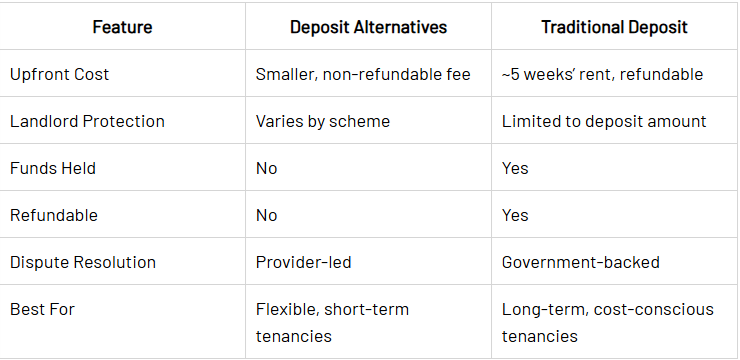
Important Considerations
Key Points
Claim process and timelines
Level and scope of coverage
Tenant profile and referencing
Portfolio strategy
Deposit alternatives complement good management but don't replace it.
FAQ
Are deposit alternatives safer than traditional deposits?
Coverage can be higher in some schemes, but outcomes depend on documentation, claims, and tenancy management.
Do tenants still pay for damages?
Yes. Tenants remain liable for rent arrears, damage, or breaches.
Does it prevent disputes?
No, but clear processes and documentation can reduce delays and uncertainty.
Can landlords choose not to use them?
Absolutely. Adoption is optional
Are they suitable for all properties?
No effectiveness varies with location, tenant demand, and landlord preference.
What documentation do I need for a successful claim?
You should maintain:
A detailed inventory at move-in and move-out
Clear photographic or video evidence of property condition
Signed tenancy agreements and addendum's
Records of communications with tenants regarding issues or breaches
Does using deposit alternatives affect my insurance?
Generally, it does not but it's important to check with your insurance provider. Some policies may have clauses regarding tenant deposits, so confirm whether alternative schemes are acceptable.
How quickly can I recover costs?
Recovery times vary by scheme and claim complexity. Simple claims may be processed in a few weeks, while disputes can take longer. Proper documentation and clear evidence usually speed up the process.
Conclusion
Deposit alternatives offer flexibility, lower upfront costs, and faster move-ins, benefiting both tenants and landlords.
However, they do not replace deposits entirely. Proper tenant referencing, detailed inventories, clear agreements, and good management remain essential for a smooth tenancy.
When used selectively and with understanding, deposit alternatives can complement your approach, making renting more accessible for tenants while helping landlords manage risk efficiently.
Some handy links for moving. Get packing tape and labels. Get the right boxes. Do your repairs before you move out to reduce claims from your deposit like cleaning products, filling holes with proper wall filler.
Thinking if accepting a deposit alternative?
Speak to us before you decide.
Email us at info@gateway.propertyhub.co.uk
Subscribe to our YouTube channel to learn more: Gateway Property TV